

Some Amerine laities, inspired by God, donated some houses and some beds in order to help poors and pilgrims, so they can be hosted free of charge in Amelia, and for this purpose they organized and called these houses and the association founded by them Fraternity of S. Maria
THE FRATERNITY OF SANTA MARIA DEI LAICI HOSPITAL
This building was created with the main purpose of hosting pilgrims and providing accommodation for travelers. Over time, these accommodation facilities also took on the task of treating those who fell ill on the street until this second function became predominant, giving rise to the modern meaning of the term “hospital”.
Since the first years of century XII there is certain news about the existence in the surroundings of Amelia of a hospice for wayfarers, the S. Giacomo one, which stood where the Capuchins Conent is now located, in via Amerina, in the on the side of the road Todi / Perugia, direction Rome, about 3 km north from Amelia, a building currently inhabited by the Vocationist Fraternity.
Shortly afterwards, probably on the occasion of the Jubilee of 1300, two more were built, a clear sign of how the ancient Via Amerina was still one of the preferred routes for those travelling to Rome. But the preeminent hospitable structure in Amelia was the one located within the city a short distance from the main gate, managed by the Fraternity of Santa Maria dei Laici. The original statute that has survived to this day dates back to 1355 and was exhibited, as an admirable example, in the great exhibition in Palazzo Venezia “Romei e Giubilei” on the occasion of the Great Jubilee of 2000, the hospital in Amelia being considered one of the oldest in Italy still functioning (thus without interruption) from the moment of its foundation.
Donations and bequests from private citizens increased the Fraternity’s income to such an extent that it was able to offer a conspicuous contribution of 100 ducats for the foundation in 1470 of the Monte di Pietà (pawnbroker’s hospice), which was established in the very same hospice to combat the scourge of usury and act as a bank for the poorest and neediest citizens and peasants. One of the first in Italy, considering that the first ever was established in Perugia in 1462, on the initiative of the Franciscan friar Barnaba Manassei da Terni.
In the early 1500s, a new hospice was built next to the old one run by the fraternity of Santa Maria dei Laici: the Ospitale di San Leonardo, thanks to donations from Pietro Racani, a wealthy merchant from Amero, the last of which took place in 1505. From then on, the management of the new hospital was entrusted to the Order of the Canons of St. Anthony of Vienne, from which it then took the name Ospitale di Sant’Antonio. The Antonians specialised in the treatment of ergotism or ‘St Anthony’s fire’ as well as the more serious infectious diseases, which were widespread at the time. From this moment on, the life of the two hospitals side by side proceeded hand in hand. In the meantime, in 1570, the Confraternity of San Giovanni Decollato had also been founded, which had received from the Confraternity of Santa Maria dei Laici the use of an oratory located behind the hospital church. Numerous structural renovations to the building can be attributed to this period, also following an event believed to be miraculous (sweat appeared on the image of the Madonna worshipped by the original Fraternity) that forced the Municipality to donate a substantial contribution to enlarge and decorate the primitive chapel built under the arches along the street.
In 1772, Bishop Struzzieri decreed the suppression of the hospice of the Antonians, transferring it and its considerable assets to the hospice of Santa Maria dei Laici, which continued to operate in this structure for a further twenty years or so, until it was gradually transferred to the suppressed monastery of St. Stephen’s, where the current civil hospital still operates today, the completion of which is known to have taken place in 1796.
With the transfer of hospital activities to the new site, the gradual dismemberment of the old hospital began, following which only the church, the adjacent oratory and the adjoining premises, run by the Confraternities of the Misericordia and San Giovanni decollato, remained active.
In the 1960s, the premises of the Confraternities, known as the Ospedaletto, were turned into a Cultural Centre dedicated to St Fermina, the town’s patron saint.
Other parts of the ancient hospice have come to private individuals over time, in various capacities. One of these, where the main nucleus of the hospice and the monte di pietà stood, came to the Ercolani family and was donated by the last descendant, Severino, to the parish of St Francis at the beginning of the 1990s, where the Foundation for the Path of Light is currently based, which, as in ancient times, is dedicated to welcoming pilgrims passing along the Via Amerina.
FORMER CHURCH OF MERCY SANTA MARIA DEI LAICI
The church facing Via della Repubblica consists of three communicating rooms, with a side entrance obtained by filling in the arches of a pre-existing portico.
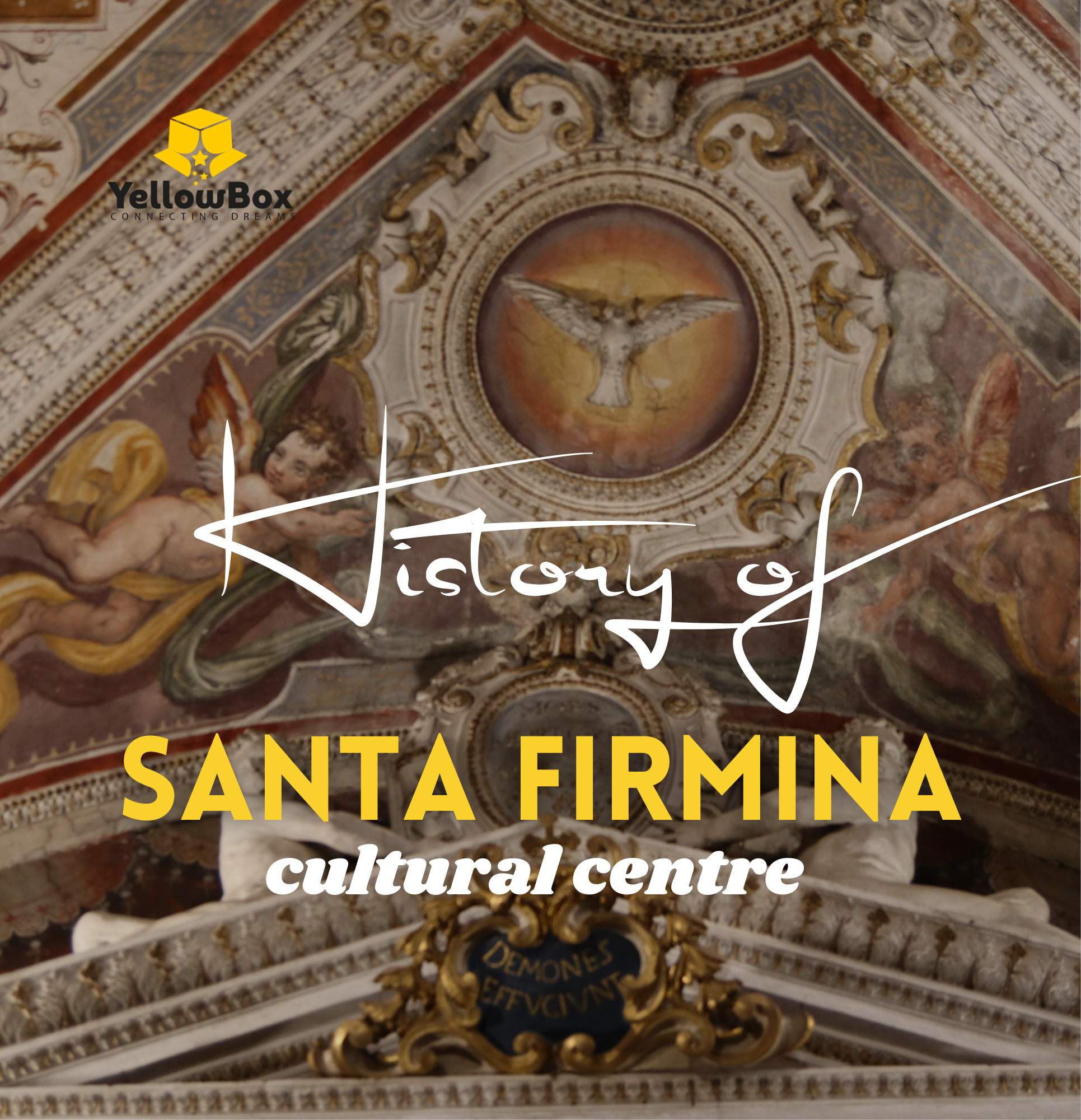
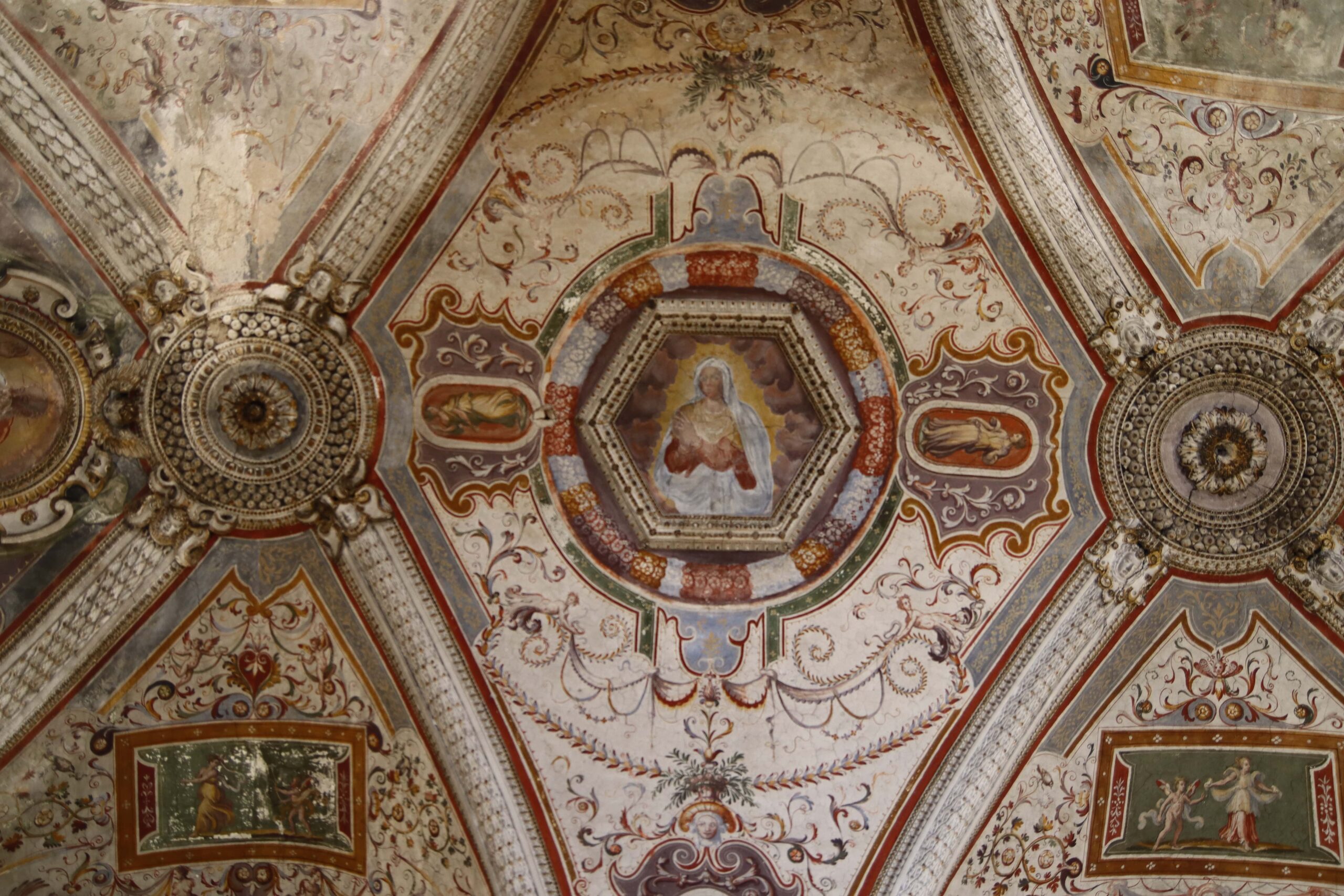
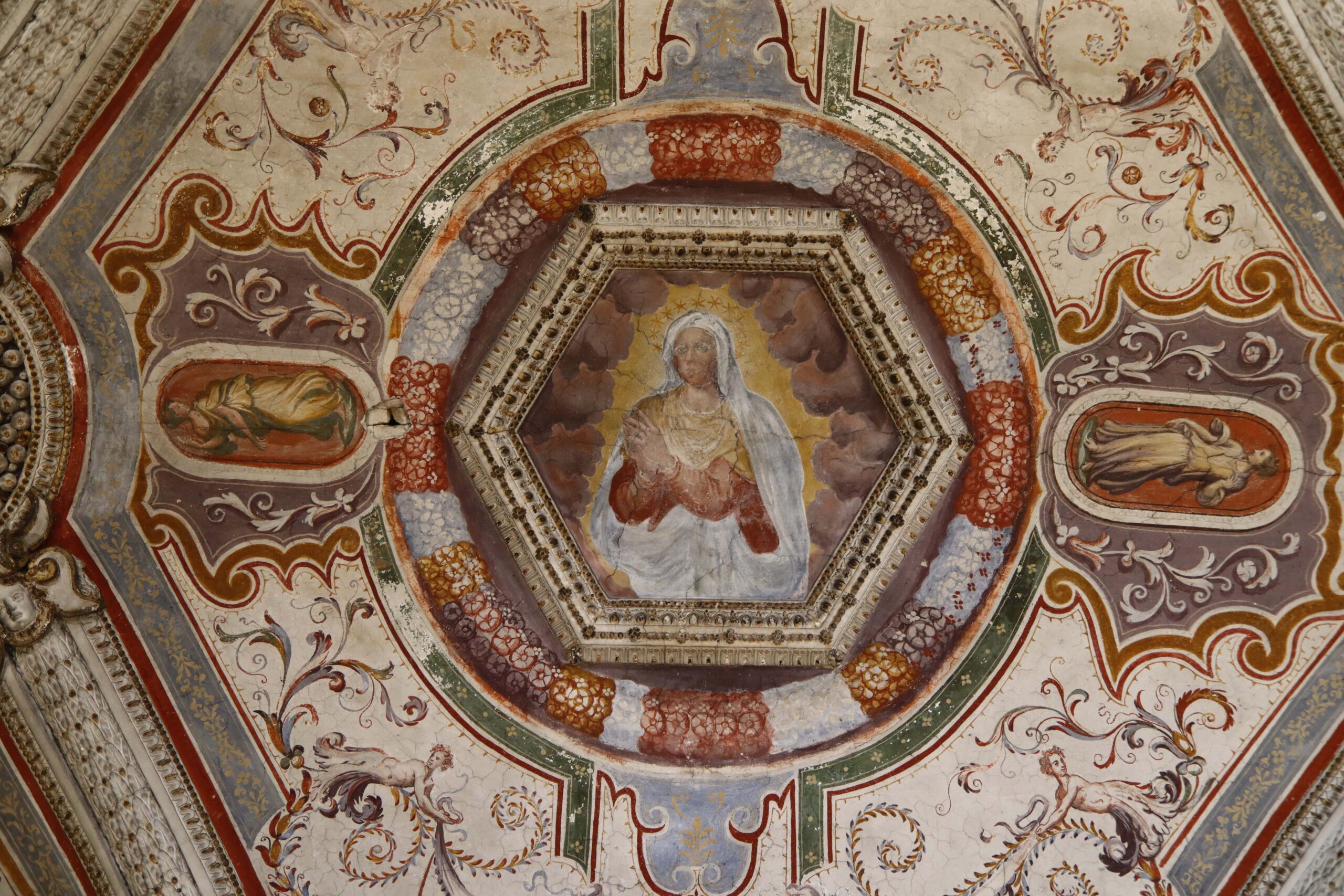
The ceiling is decorated with frescoes in a grotesque style, in the central part of the vault is a depiction of the Virgin Orante inside a hexagonal medallion framed by a floral garland, from which four female figures on a red background in the Pompeian style depart; on the sides above the altars we see the Holy Spirit and God Almighty on the left framed in oval medallions. The grotesque style, typical of the late 16th century, can be found in Amelia as decoration on several monuments such as the Farrattini Chapel in the Cathedral attributed to the Zuccaris and in the ceilings of the noble Palazzo Petrignani. The vault of the church is what remains of a complex stucco and fresco ornamentation that is certainly more extensive and has been modified near the two side walls, perpendicular to the entrance.
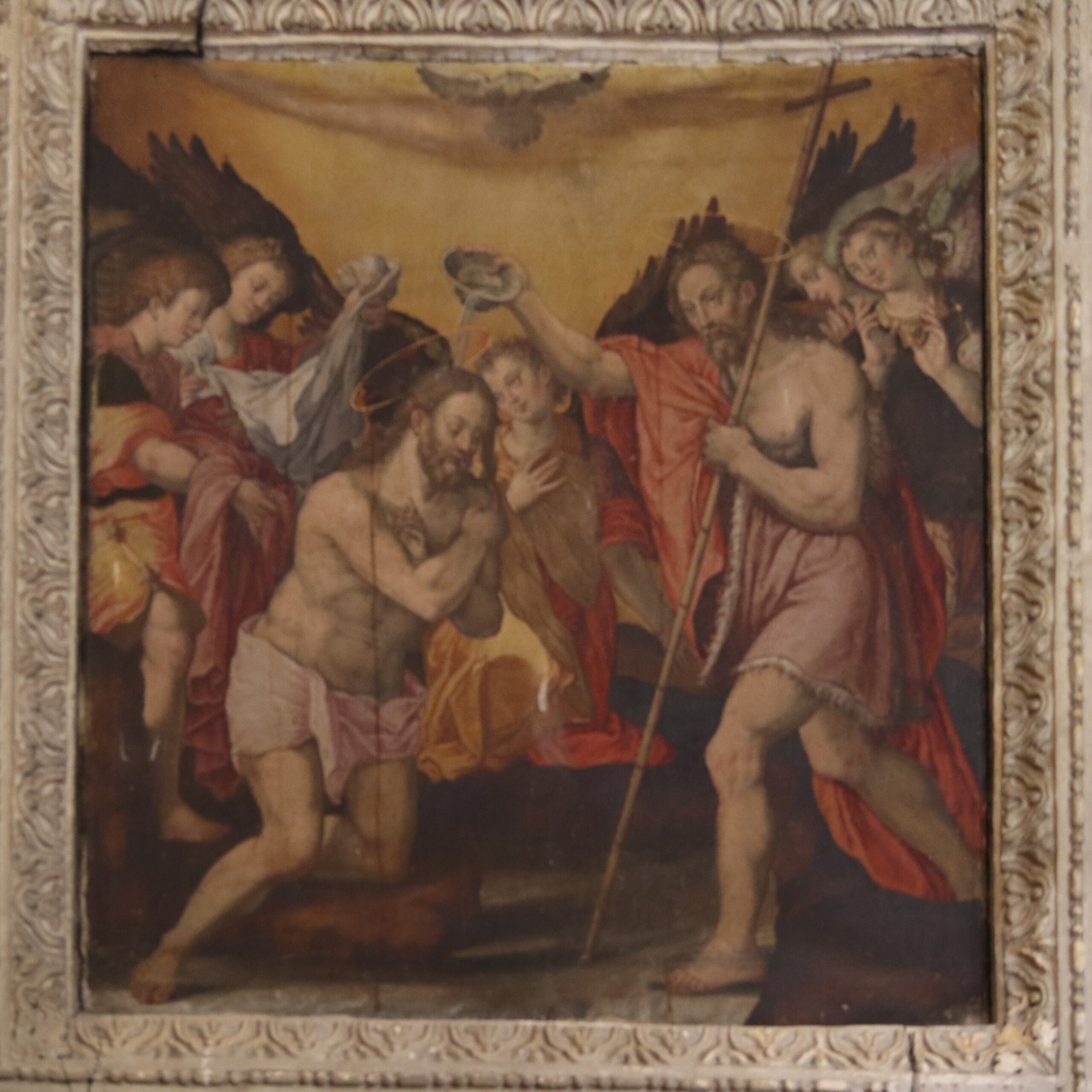
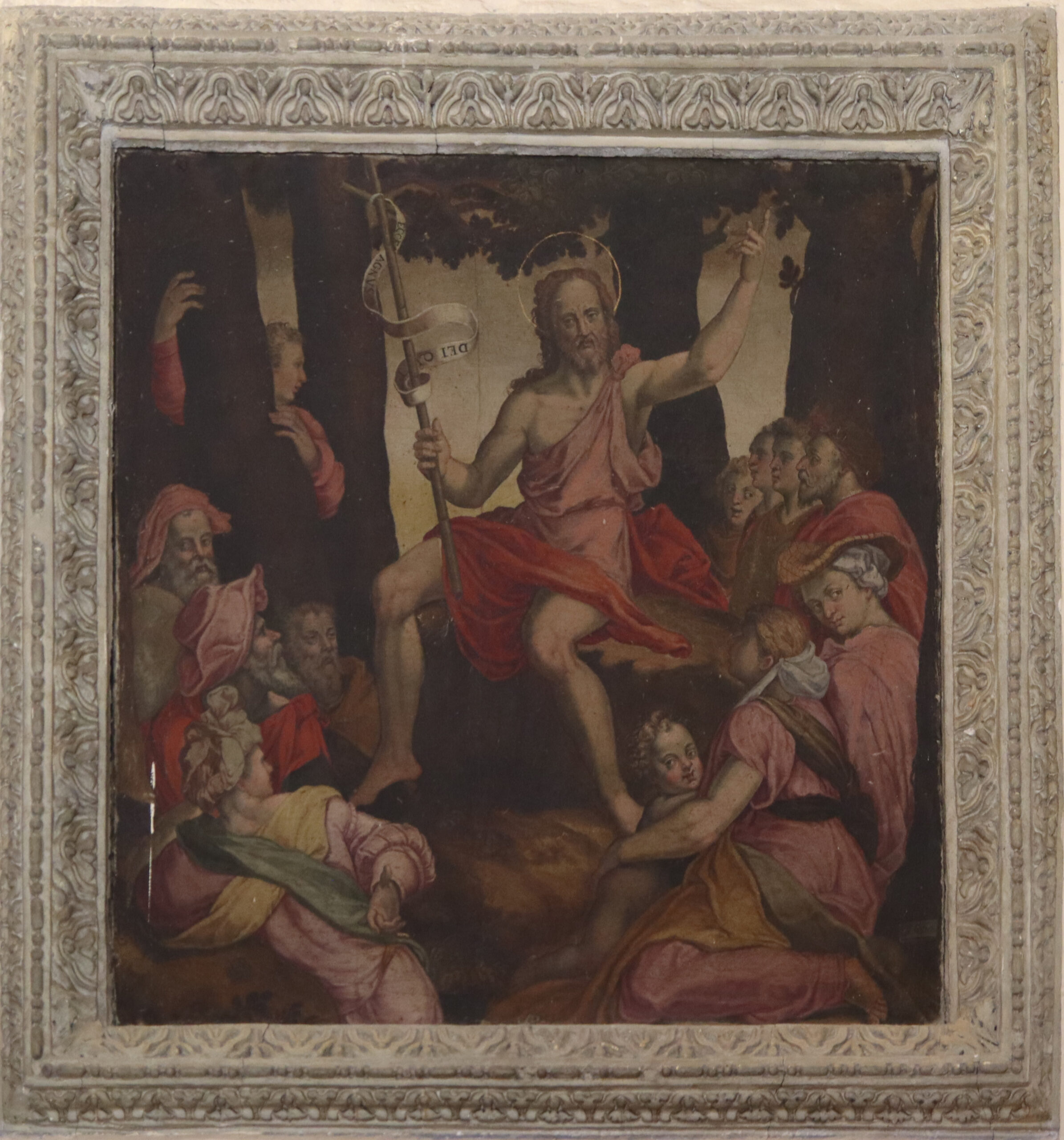
On either side of Agresti’s work are two canvases depicting The Baptism of Saint John the Baptist and The Preaching of the Saint to the People, attributed to Liotardo Piccioli, a pupil of Agresti himself. One of the two canvases bears the date 1604, an important chronological reference for dating a second decorative phase linked to the transformation of the Oratory. The two altar elevations must have been made on this date.
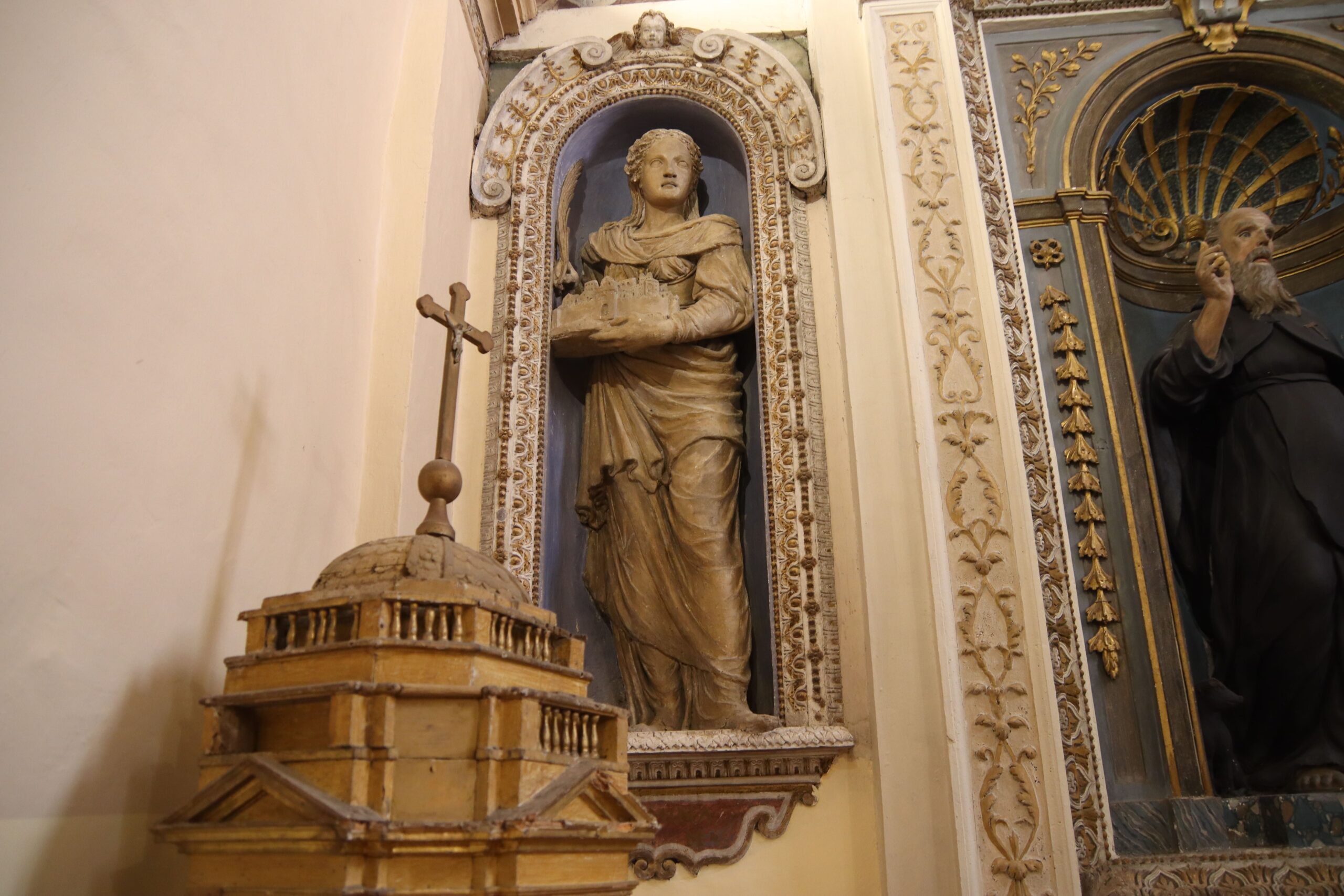
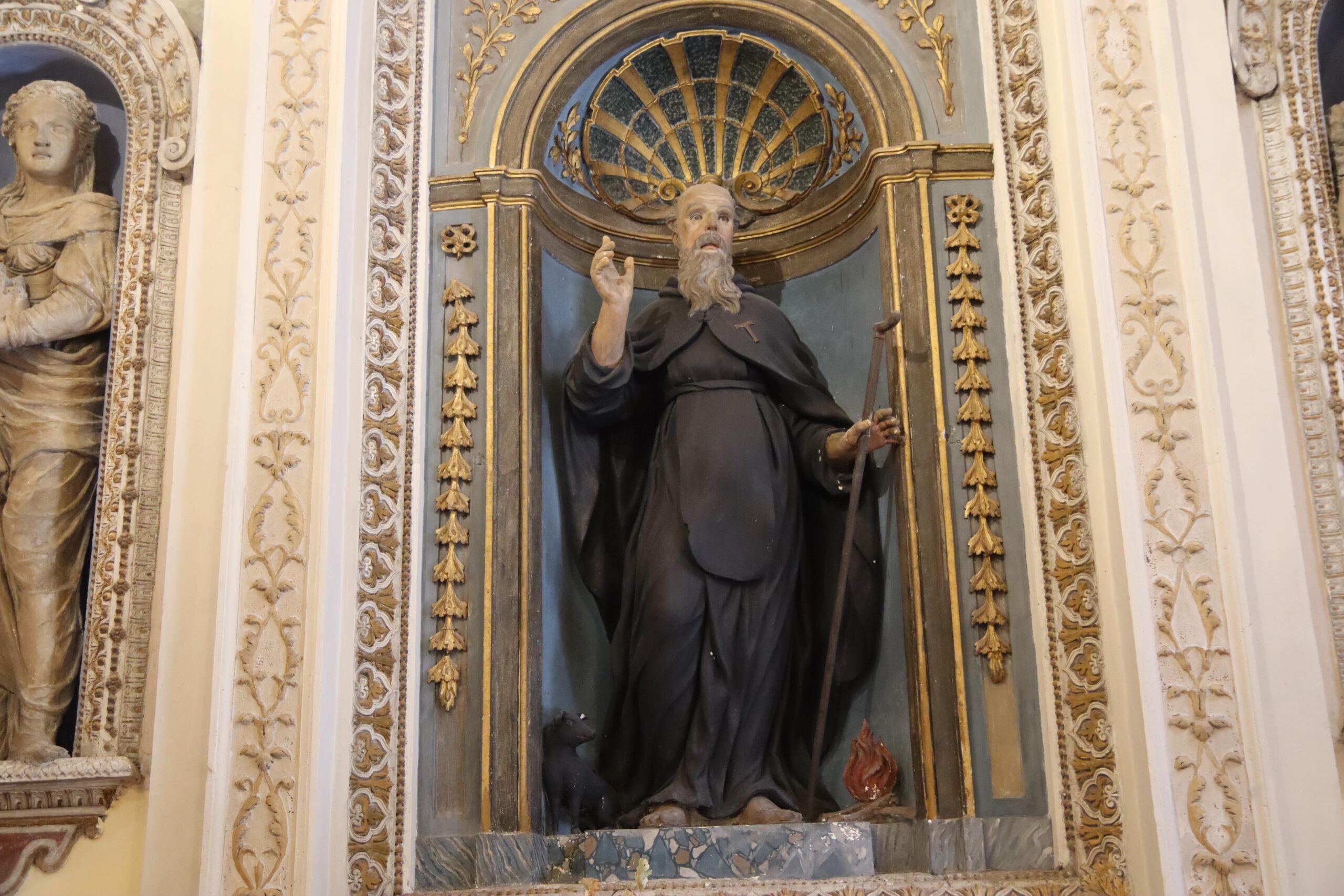
The altar to the right of the entrance has at its centre the polychrome sculpture of St. Anthony Abbot, in memory of the period when the hospice was run by the monks of St. Anthony of Vienne, who dedicated themselves to caring for pilgrims suffering from the ‘St. Anthony’s fire’, shingles, and also for those affected by other serious infectious diseases, such as plague and cholera. On either side of the saint are the two classical monochrome statues of the patron saints of the city of Amelia Saint Fermine holding the city of Amelia and Saint Olympias dressed as a Roman soldier. The two Saints in a similar position are found at the sides of the Crucifixion in the painting by Livio Agresti (1557) now in the Archaeological Museum.
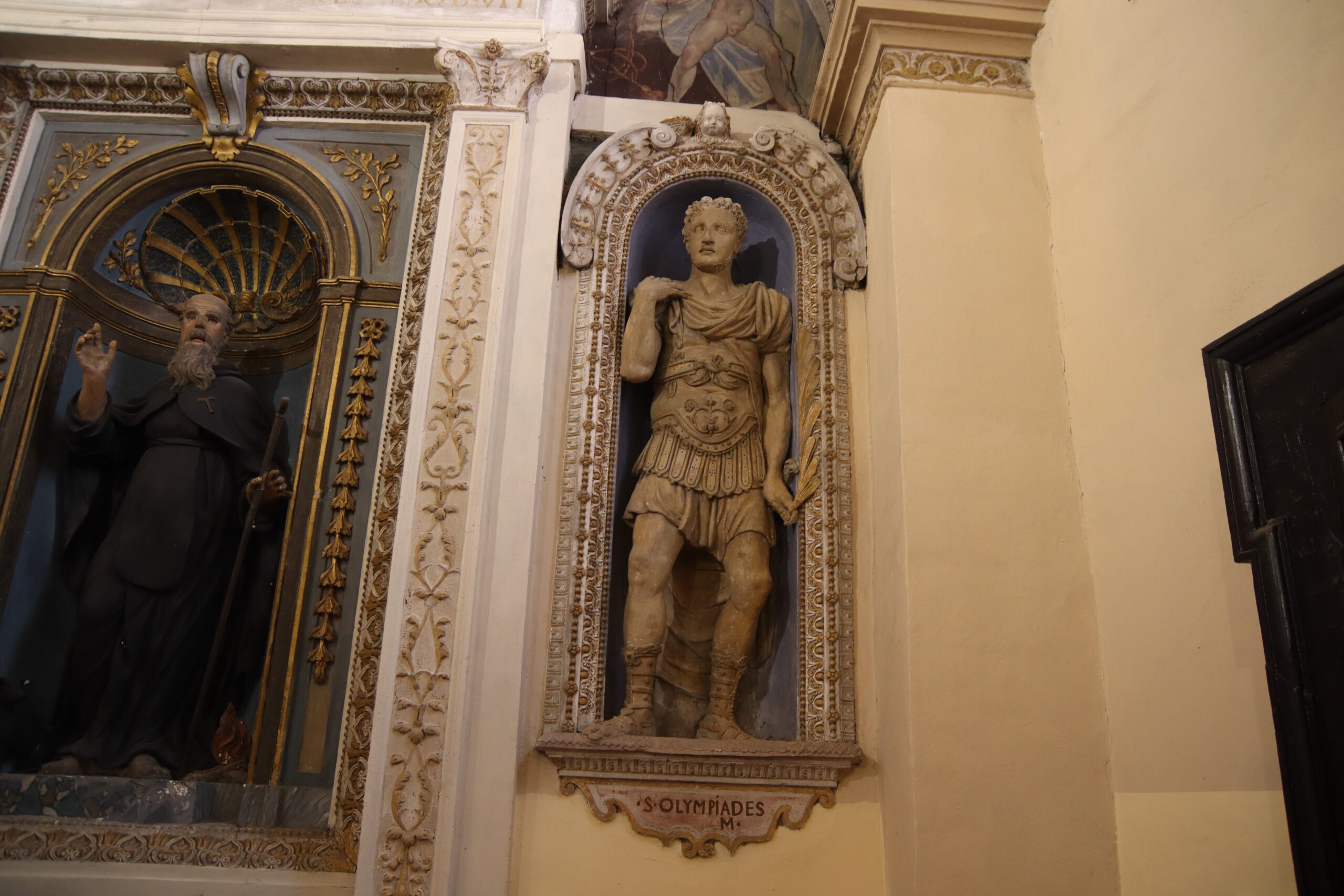
On the altar to the left, in the centre is an image of the Madonna that has always been worshipped here, but the original work cannot be traced, while the Madonna that is worshipped on the altar today is certainly later (late 17th century) and completely different from the primitive image (one presumes) that was painted directly on the wall. On either side of the Madonna, inserted into niches decorated with gilded stuccoes, we have sculptures of St John the Evangelist on the right and St John the Baptist on the other side.

In 1570, the Confraternity of Mercy of Amelia received the use of the oratory located behind the hospital church on the occasion of its aggregation to the Company of St John Beheaded of Rome. This entailed the transformation of the Misericordia church into an Oratory, which saw important interventions such as the closing of the portico, a new orientation of the church, and the creation of two altar façades whose typology can be attributed to the Grimani brothers, who were also active at that time in Stroncone, where they built another very similar Oratory of St. John the Beheaded (1575-1595).
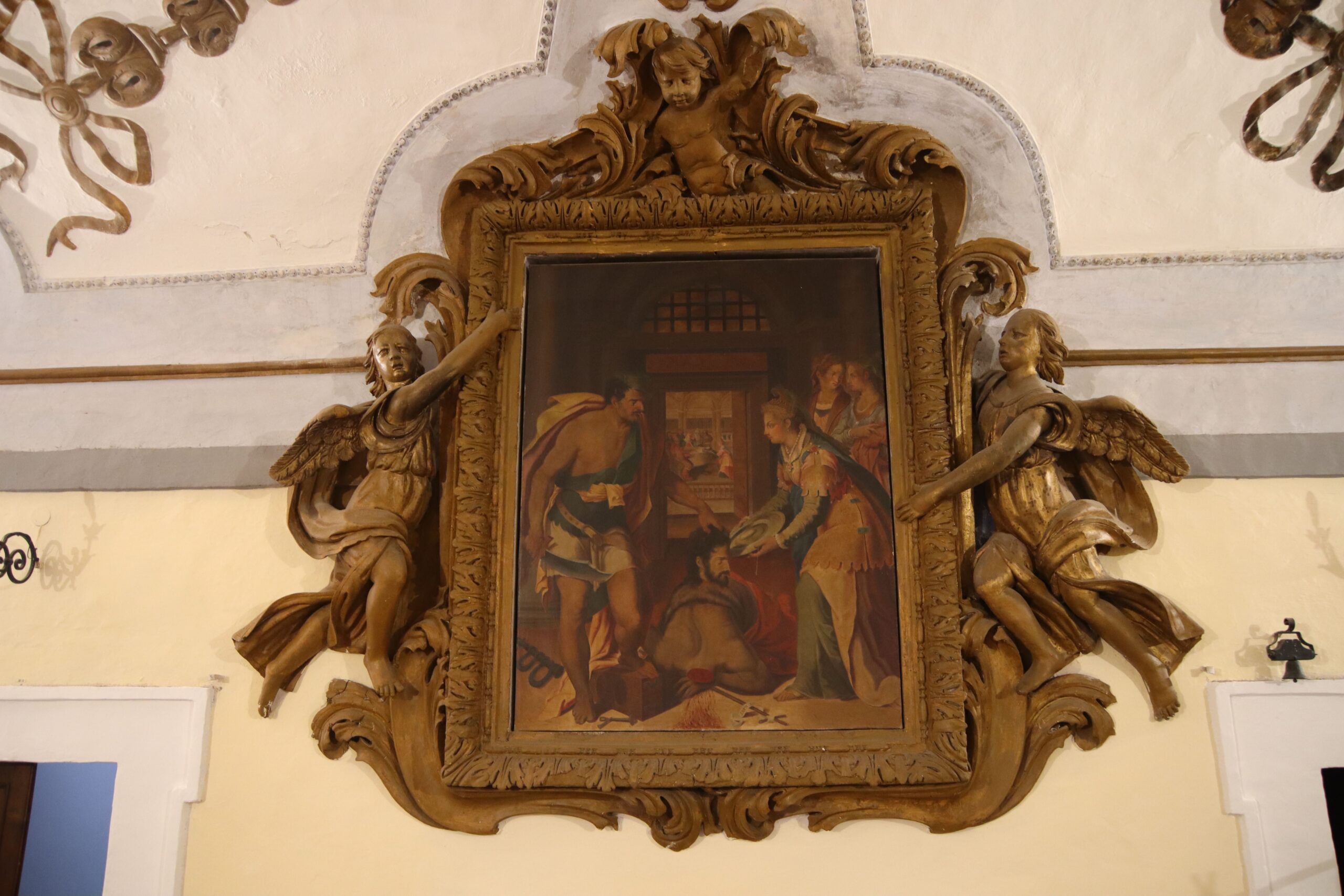
In the coworking room, we find a copy of “The Beheading of the Baptist” on oil on panel, signed and dated 1571, by the Forlì painter Livio Agresti known as Ricciutello. Testifying to the close bond Agresti had with the Confraternity, this same work was replicated equally for the similar oratory in Lugnano in Teverina (1573).